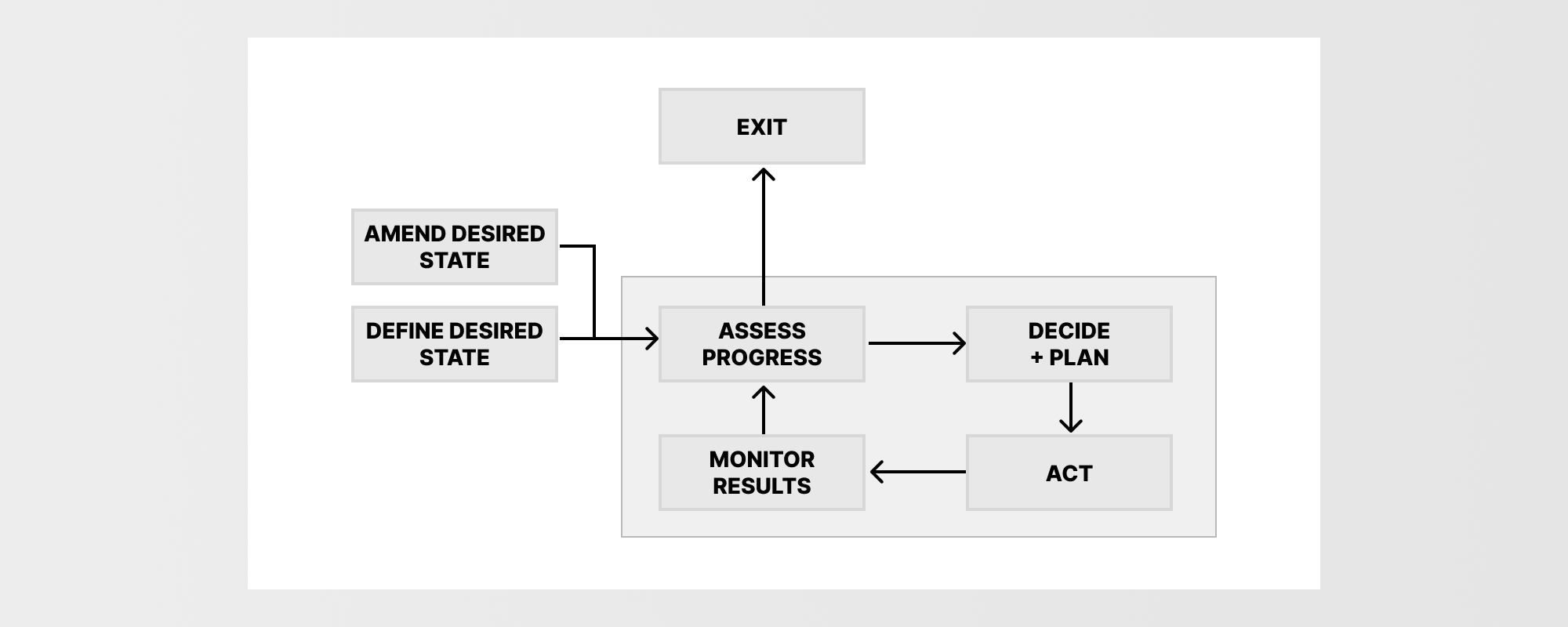
I’m pleased to share my latest article introducing the Teleopraxis model, a framework designed to guide purposeful change. The article builds on my Argument Claim Hexagon model and focuses on the unique challenges of claims of action and decisions about what should be done.
Most reasoning deals with facts, causes, definitions and classifications, interpretations, or evaluations. These claims can be tested, refined, and updated as new information comes to light.
Claims of action, however, are different. They are judged by real-world results and require an ongoing process of feedback, iteration, and adjustment. Existing frameworks like Boyd’s OODA loop and Deming’s PDCA cycle highlight iteration but don’t capture the full complexity of how action claims work in practice.
That’s where the Teleopraxis model comes in. I define teleopraxis as “the taking of purposeful action to close the gap between an entity’s current state and its desired future state”.
The model has six pillars:
- clarity about goals
- feedback
- iterative cycles
- error correction
- sustaining motivation
- understanding the role of the different argument claims types.
It provide a structured way to move from intention to results, whether applied to an individual, an organisation, or even a society.
In the article, I outline both the reasoning behind the model and a simplified version of the model.
If you’re interested in frameworks for reasoning, decision-making and creating effective change, I hope you’ll find it a useful and thought-provoking read.